Tell us about the job
Takes about a minute. No obligation.
A contractor pricing a central AC repair in Randolph County has to work out what actually wore the system down before they can give a homeowner an honest diagnosis. 54 severe weather events were recorded in Randolph County, Indiana between 2015 and 2024. At that rate, severe weather is part of life here without being the dominant load on every system. A compressor or capacitor that has given out is more likely to have gotten there through years of deferred service or a marginal original install than through storm load alone. The contractor checks refrigerant levels, electrical contacts, and filter condition first, because those are what accumulate quietly and what the repair bill usually traces back to.
Ductwork in a house this old has been asked to carry whatever each decade's replacement unit demanded of it, and the adaptations accumulate. Half the homes in Randolph County, Indiana were built in 1958 or earlier (2020-2024 ACS 5-year). By the time a central AC system fails and a contractor opens it up, the components inside often belong to a lineage of repairs rather than a single original install, and the parts a given unit takes may no longer be in production. That is what shapes the scope: whether a replacement part exists, and whether what is already in the walls will work with one.
The Parts of a Central AC a Contractor Checks During Repair
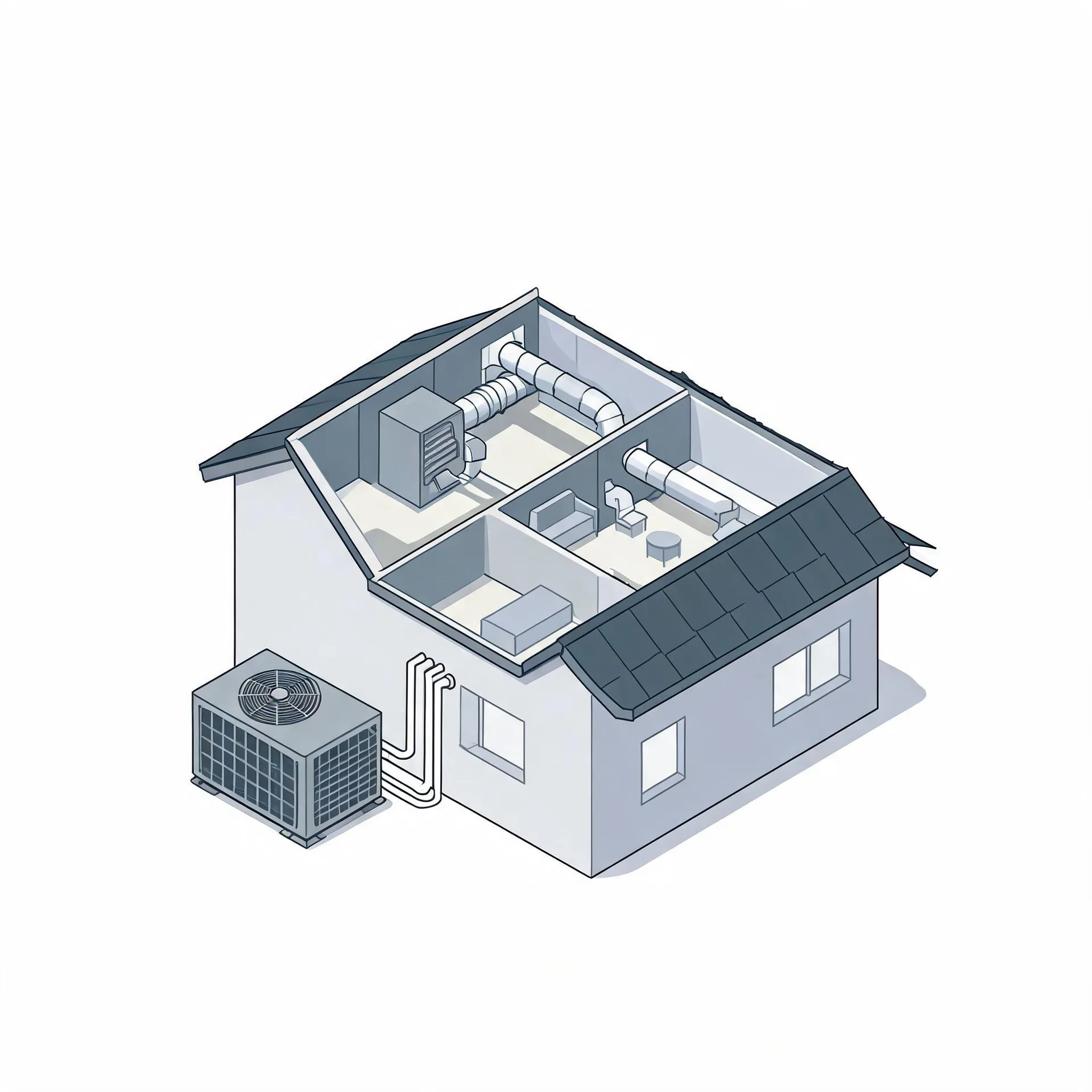
The outdoor condenser unit sits outside the house, usually on a concrete pad at ground level, and it houses the compressor and condenser coil. These are where a contractor looks first when the system runs but produces no cooling, or when it cycles on and off without finishing a full run. The air handler or furnace cabinet inside the house holds the evaporator coil, and a frozen or fouled coil there is a common reason a system blows warm air.
The refrigerant lines run between the two units, and a leak anywhere along them will show up as reduced cooling before anything else fails outright. The thermostat on the wall and the contactor inside the outdoor unit are smaller parts, but either one can stop the whole system cold while every major component is still physically sound.
The drawing shows how these parts relate in a typical installation, and a licensed contractor assesses which of them apply and what condition they are in for your specific house.
Find a contractor in Randolph CountyRandolph County, by the numbers
54 severe weather events were recorded in Randolph County, Indiana between 2015 and 2024.
NOAA National Centers for Environmental Information, Storm Events Database, bulk CSV export, events 2015-01-01 through 2024-12-31.Half the homes in Randolph County, Indiana were built in 1958 or earlier (2020-2024 ACS 5-year).
U.S. Census Bureau, 2020-2024 American Community Survey 5-Year EstimatesRandolph County, Indiana holds 11,412 housing units (2020-2024 ACS 5-year).
U.S. Census Bureau, 2020-2024 American Community Survey 5-Year EstimatesOwners occupy 77.3% of the occupied homes in Randolph County, Indiana (2020-2024 ACS 5-year).
U.S. Census Bureau, 2020-2024 American Community Survey 5-Year EstimatesCodes & Standards Covering Central AC Repair in Randolph County, Indiana8 sourced rules and standards
What the repair visit looks like
Split-system central air conditioners rated below 45,000 Btu/h manufactured on or after January 1, 2023 must meet a federal minimum of 13.4 SEER2.
Split-system central air conditioners rated at or above 45,000 Btu/h manufactured on or after January 1, 2023 must meet a federal minimum of 13.4 SEER2.
Split-system central air conditioners manufactured between January 1, 2015 and December 31, 2022 had to meet 13 SEER, the metric that preceded SEER2.
Single-package central air conditioners manufactured on or after January 1, 2023 must meet a federal minimum of 13.4 SEER2.
Space-constrained central air conditioners manufactured on or after January 1, 2023 must meet a federal minimum of 11.7 SEER2.
Federal efficiency standards for split-system central air conditioners and heat pumps are set on each certified combination of outdoor unit and indoor coil rather than on the outdoor unit alone.
Residential and light commercial air conditioning and heat pump systems assembled in the field, including mini-splits and unitary systems, may not be installed on or after January 1, 2025 using a refrigerant with a global warming potential above 700.
A field-assembled system whose specified components were all manufactured or imported before January 1, 2025 carries no installation compliance date under the refrigerant restrictions and may still be installed.
Severe Weather Events in Randolph County
Hard weather puts hours on HVAC equipment fast, stressing components that run longest under the worst conditions. Repair needs in Randolph County track with what the local climate demands, which is why the pattern here matters more than a national average.
54 severe weather events, 2015–2024. Source: NOAA National Centers for Environmental Information, Storm Events Database.