Tell us about the job
Takes about a minute. No obligation.
A contractor quoting a central AC repair in White County has to decide what actually wore the system down. 55 severe weather events were recorded in White County, Indiana between 2015 and 2024. At that rate, severe weather is a real but infrequent presence, and a compressor or capacitor that has given out is far more likely to trace back to years of deferred service or original installation quality than to storm exposure. That distinction changes what a contractor prices first and what they pull apart before writing the repair scope.
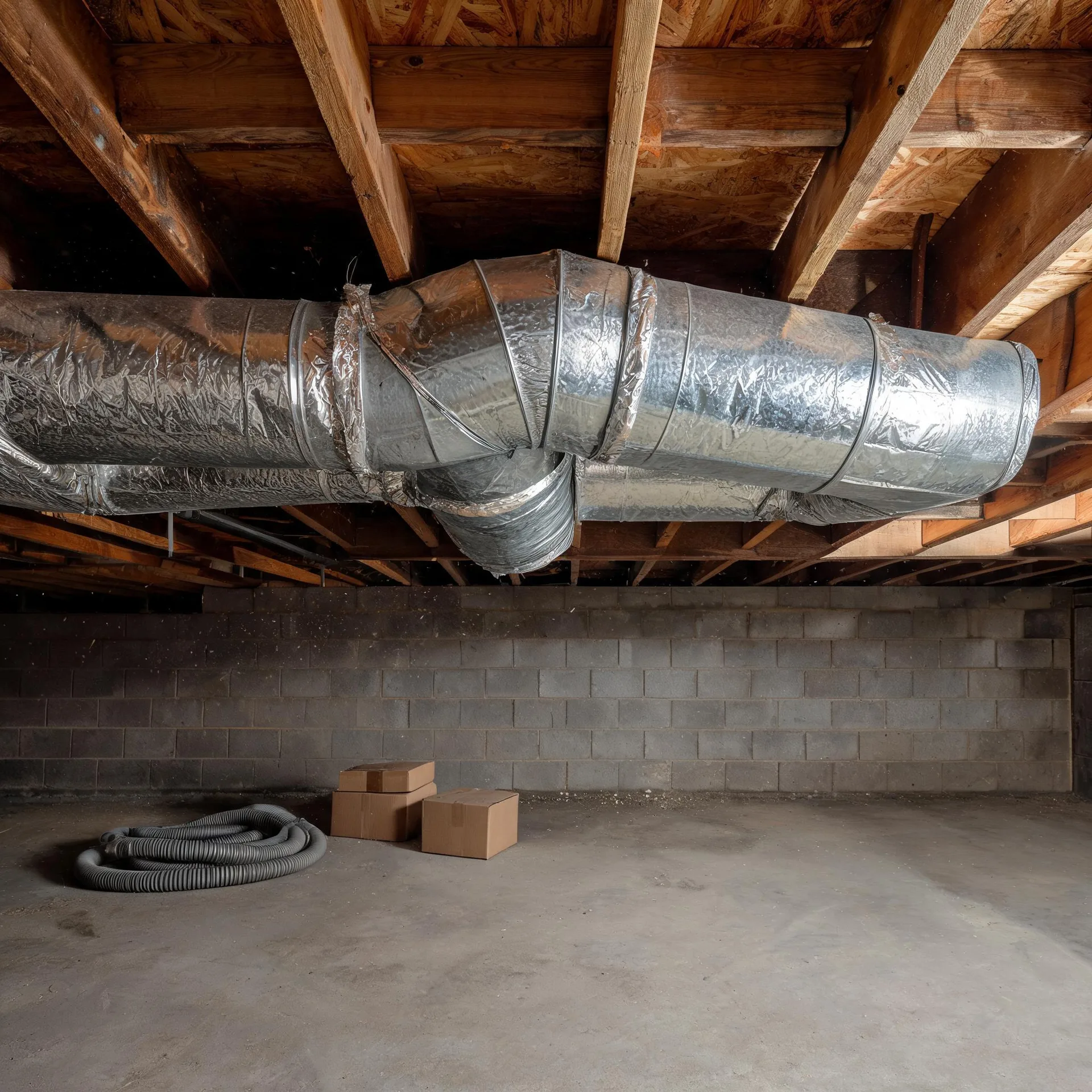
Ductwork in a house carries the history of every system that ran through it. Half the homes in White County, Indiana were built in 1969 or earlier (2020-2024 ACS 5-year). A central AC repair in stock that old often opens onto conditions the current unit inherited rather than caused: segments patched by a previous contractor, insulation that has dried and separated, or connections that were never sized for the equipment now attached to them. A contractor working through a repair here checks what is upstream of the fault as carefully as the fault itself, because a worn capacitor or a refrigerant loss can be the symptom of a duct system that has been working against the unit for years.
The Parts of a Central AC a Contractor Checks First
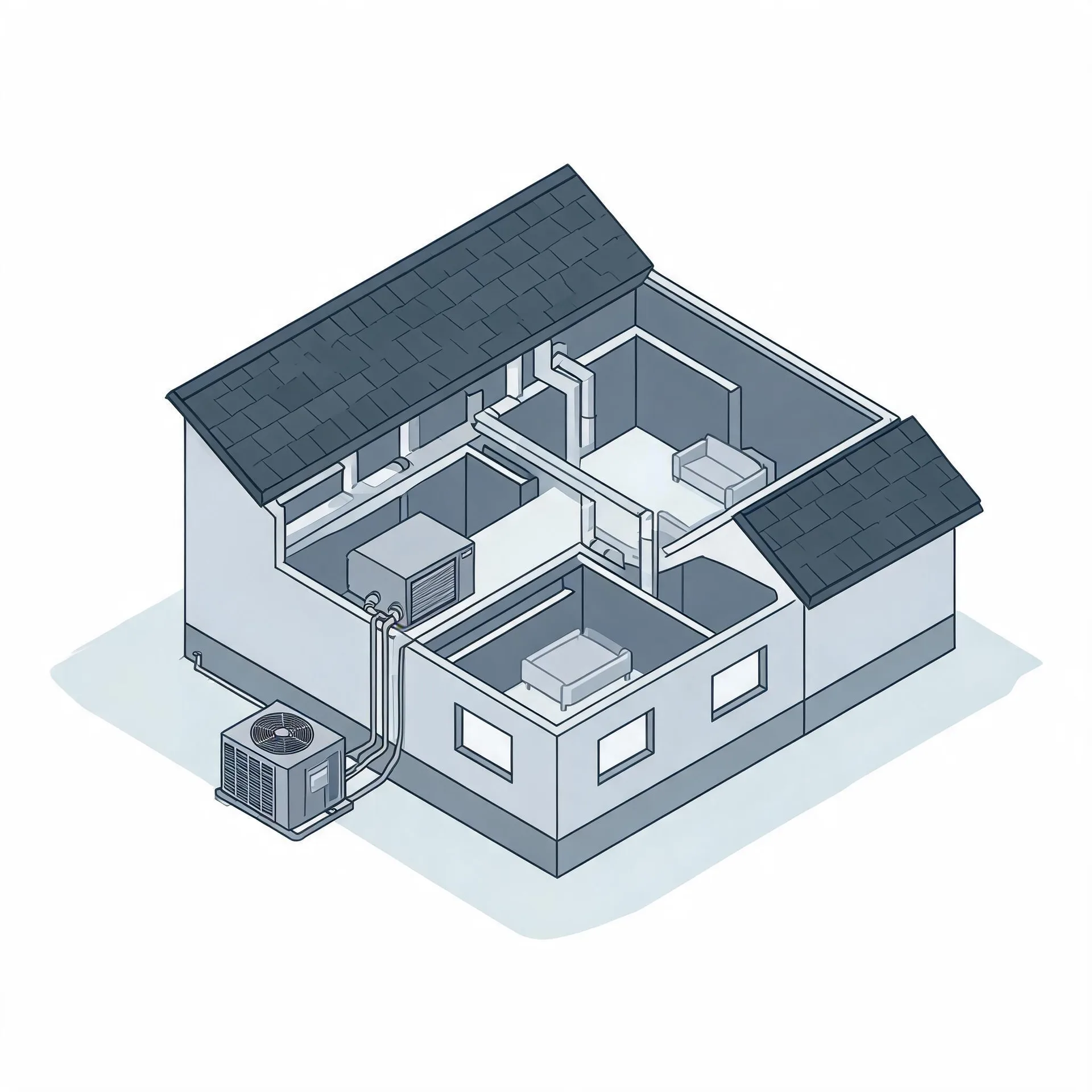
The outdoor condenser unit sits outside the house, usually on a concrete pad along an exterior wall, and it is where the system sheds heat to the outside air. The compressor lives inside that cabinet and is often the first place a contractor looks when a system runs but does not cool. The refrigerant lines connecting the two units also draw early attention, since a leak there quietly undermines everything else.
Inside the house, the air handler or furnace cabinet holds the evaporator coil, which is the cold surface that pulls heat out of your indoor air. The blower fan inside that same cabinet moves air across the coil and pushes it through your supply registers. The contractor also checks the condensate drain, a small line that carries away the moisture the coil collects, because a clogged drain can shut the system down or cause water damage.
The drawing shows the general layout of a central AC system, and a licensed contractor determines which components and conditions apply to your specific house.
Find a contractor in White CountyWhite County, Indiana, by the numbers
55 severe weather events were recorded in White County, Indiana between 2015 and 2024.
NOAA National Centers for Environmental Information, Storm Events Database, bulk CSV export, events 2015-01-01 through 2024-12-31.Half the homes in White County, Indiana were built in 1969 or earlier (2020-2024 ACS 5-year).
U.S. Census Bureau, 2020-2024 American Community Survey 5-Year EstimatesWhite County, Indiana holds 12,961 housing units (2020-2024 ACS 5-year).
U.S. Census Bureau, 2020-2024 American Community Survey 5-Year EstimatesOwners occupy 81.0% of the occupied homes in White County, Indiana (2020-2024 ACS 5-year).
U.S. Census Bureau, 2020-2024 American Community Survey 5-Year EstimatesCodes & Standards Governing Central AC Repair in White County, Indiana8 sourced rules and standards
What Happens When a Contractor Comes Out
Split-system central air conditioners rated below 45,000 Btu/h manufactured on or after January 1, 2023 must meet a federal minimum of 13.4 SEER2.
Split-system central air conditioners rated at or above 45,000 Btu/h manufactured on or after January 1, 2023 must meet a federal minimum of 13.4 SEER2.
Split-system central air conditioners manufactured between January 1, 2015 and December 31, 2022 had to meet 13 SEER, the metric that preceded SEER2.
Single-package central air conditioners manufactured on or after January 1, 2023 must meet a federal minimum of 13.4 SEER2.
Space-constrained central air conditioners manufactured on or after January 1, 2023 must meet a federal minimum of 11.7 SEER2.
Federal efficiency standards for split-system central air conditioners and heat pumps are set on each certified combination of outdoor unit and indoor coil rather than on the outdoor unit alone.
Residential and light commercial air conditioning and heat pump systems assembled in the field, including mini-splits and unitary systems, may not be installed on or after January 1, 2025 using a refrigerant with a global warming potential above 700.
A field-assembled system whose specified components were all manufactured or imported before January 1, 2025 carries no installation compliance date under the refrigerant restrictions and may still be installed.
Severe Weather Events in White County
Weather puts real hours on cooling equipment. The harder a system works to keep up with what the sky delivers, the sooner its parts wear out and call for repair.
55 severe weather events, 2015–2023. Source: NOAA National Centers for Environmental Information, Storm Events Database.